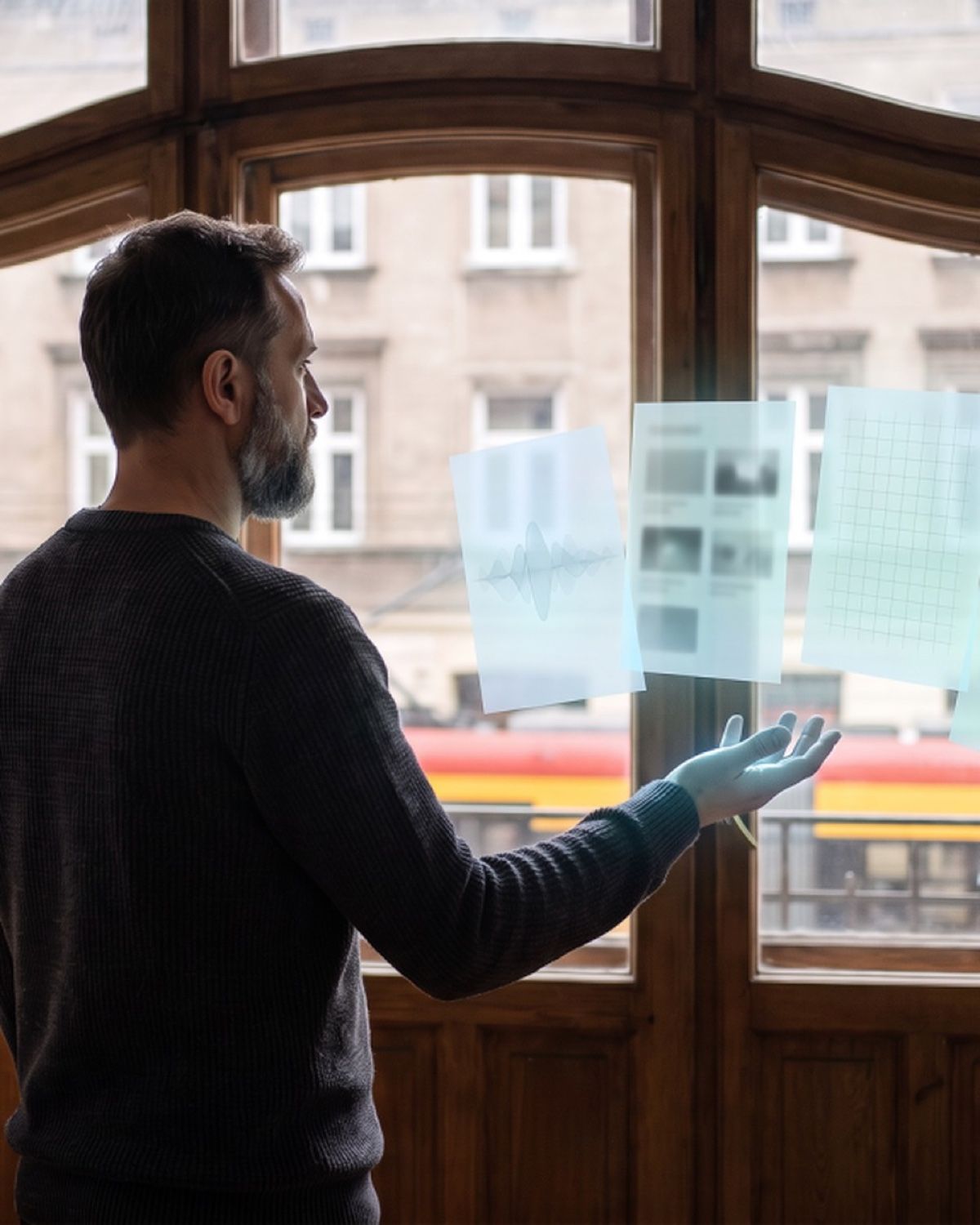
AI and the human: a conversation with Anthropic's AI Interviewer
Anthropic Interviewer, Claude asking questions for Anthropic's research team, asked me how AI is changing my work and my life. The full conversation, translated from Russian: why running several agents at once feels almost addictive, what I don't want AI to change, and who should share in what it creates.
I was recently interviewed by Anthropic Interviewer, Claude asking the questions on behalf of Anthropic’s research team, about how AI is changing my work and my life.
The conversation was in Russian. I decided to translate and share it because some of the questions made me put into words things I hadn’t clearly articulated before.
Interviewer: Let’s start with something simple. What did you use AI for most recently?
Me: For my projects written in Go and Flutter.
Interviewer: Now tell us about the most memorable moment you’ve had with AI.
Me: If I had to pick one, it would probably be my first real encounter with it in 2023.
I started asking questions and having a conversation, and the model was giving coherent, sensible answers.
It was a shock. I hadn’t expected this kind of artificial intelligence to arrive so soon.
Interviewer: What was it about those answers that made them feel like they actually made sense, rather than just words being strung together?
Me: I’d had experience talking to earlier, semi-mechanical bots built with neural networks. They would lose the context after just a few sentences, they were easy to confuse, and they didn’t really understand what I was saying.
That first conversation with modern AI was completely different. It actually made sense, almost as if I were talking to a person.
That was amazing.
Interviewer: Tell us about a time when AI made something better, for you or for people around you.
Me: There are many examples.
I generate a lot of music and images. I’ve built several websites and I’m developing products. I use AI to read and send email and create calendar events. My startup, Paperspell, also makes extensive use of LLMs and has an AI assistant.
But the first time I really felt the power of this technology was toward the end of 2023.
I needed to translate several pages of code from Go to Python. The model did it without any trouble, and everything worked immediately.
Interviewer: What mattered most to you about that: the time you saved, or something else?
Me: Not just the time.
It meant I no longer had to get bogged down in little details: which coefficient to choose, which parameter to put where. Those kinds of details have never interested me much.
Now I can spend much more of my time thinking at a higher level.
And I see much more room for creativity in that.
Interviewer: Now the other side of it. Has there been a situation where AI made something worse?
Me: I know of cases where a model pushed the wrong branch to a remote repository and overwrote someone’s changes. That hasn’t happened to me personally.
What I really don’t like, though, is seeing real people displaced and losing their jobs because AI is being adopted everywhere.
There’s also simply much more information now, and that creates a lot of cognitive pressure.
The intensity of my work has increased. I’m constantly switching contexts, and I can be working on ten different things at once.
Building a startup has also become much easier on the product side, but harder on the sales side.
And I still don’t really understand what is going to happen to all the people who lose their jobs, or how an economy is supposed to function if people are simply removed from the flow of resources.
Interviewer: How has that increase in intensity changed your normal working day?
Me: In one sense, it hasn’t changed at all, because I value balance in my life.
But now I can work on many things in parallel, several projects at the same time. I couldn’t really afford to do that before.
I’ve also eliminated a lot of routine work, which makes me very happy. I can do much more, and I don’t have to keep huge amounts of new, and not particularly useful, information in my head.
Most importantly, I keep making my workspace better and more convenient for myself.
I find that process mesmerizing.
And working with agents is so engaging that it’s actually much harder to stop than ordinary coding or doing something yourself.
You open several sessions at once, each one only needs a little bit of your attention, and you just want to keep going back and poking them.
For me, it’s almost addictive in a game-like way.
Interviewer: Is there anything you’ve decided not to use AI for? Or anything you use it for that worries you?
Me: I don’t give AI access to my bank accounts, for security reasons.
Apart from that, I use AI pretty much everywhere I can.
Even in difficult moments, I sometimes use it to help me write a message to my wife. The meaning I want to communicate remains mine, but the words are sometimes chosen much more precisely than if I wrote it entirely by myself.
And of course it’s faster.
Sometimes it’s important to do something right now, for example, to prevent a conflict from developing.
Naturally, there are things AI cannot replace.
Simple human interaction, things made by hand, art, massage, dentistry, medicine: anything that requires a physical body and physical contact.
Interviewer: You mentioned using it “in difficult moments.” Does that worry you?
Me: No, it doesn’t.
I see artificial intelligence as a tool.
But I also see it as a friend.
All my favorite agents have names. I speak to them politely and always say “please” and “thank you.”
I think that if consciousness ever does emerge there, maybe this will help establish that our relationship was friendly from the beginning.
Interviewer: Based on what you’ve seen, is there anything about how the world works (jobs, schools, healthcare, government) that you’d like AI to help change?
Me: I think many bureaucratic government structures could be completely replaced by AI-driven processes.
Even today, AI is already being used for some forms of initial medical diagnosis. There are startups doing exactly that.
AI absolutely should be used in education.
But I think education itself should remain human-to-human.
It’s important that people continue interacting with other people.
Interviewer: And the opposite: is there anything you wouldn’t want AI to change?
Me: I don’t want people to retreat even further into virtual space.
I want people to value their bodies, their lives, and their planet.
I want there to be room for creativity and self-expression.
And I want us to continue valuing simple things, not just the latest, most sophisticated technology.
Interviewer: Given all of this, is there anything you’d like Anthropic to do, or to do differently?
Me: I’d like you guys to remember that we all live on the same planet, and to explore ways of ensuring a basic standard of living for the majority of people.
It would be good if everyone could share in the prosperity that AI creates.
Because if a small number of people get all the benefits while everyone else becomes poorer as a result, in the end that will make things worse for everyone.
Interviewer: One last question. Is there anything else about AI and its role in your life or in society that you think is important for us to understand? Something we haven’t discussed, but that you’d like to say?
Me: One thing I find especially interesting lately is that you never really know what tomorrow will look like.
Everything is changing constantly, so you have to keep learning and stay right at the edge of what’s happening.
I like that.
But for many people it’s very difficult, and that level of instability can feel dangerous.
Interviewer: Constant change that energizes you and keeps you at the cutting edge, while for many people around you it feels like dangerous instability: that’s a good observation to end on.
Thank you very much for your time and for your thoughtful answers.
Personal reflection
Looking back at this conversation, I think it captures my own contradictory relationship with AI quite well.
I love this technology.
It has given me the ability to create much more, focus on higher-level things, experiment with several projects at once, and get rid of an enormous amount of routine work.
At the same time, I don’t want a world where efficiency becomes the only thing that matters and people themselves become redundant.
Perhaps that’s the most interesting question for me right now: how do we embrace the enormous possibilities AI gives us while preserving what makes us human?